The Lord has established his throne in the heavens, and his kingdom rules over all.
Psalm 103:19
After telling of God’s actions and character, the psalmist reaches the heights of majestic truth in verse 19 by declaring that God is indeed the Sovereign over heaven and earth. He is King of kings and His throne is in heaven. He is not, as the deists teach, a god removed from man. On the contrary, in this one sentence, he proclaims that God is transcendent, immanent, sovereign, and all-powerful. God is transcendent in that He is absolutely and uniquely superior to everything in creation. His throne in heaven, and His greatness exceeds anything in creation. And yet, because God is also immanent, He is continuously and actively involved in all His creation. By virtue of His sovereignty, he enjoys absolute rule over creation. He is all-powerful and able to do all His holy will. Nothing that is consistent with His character is too hard or impossible for God. When I contemplate how great God is, I marvel that He even desires a relationship with me and pursues us with a steadfast, merciful, and compassionate love that forgives and cleanses confessed unrighteousness. In Revelation 4, the apostle John shares the vision God gave him of His throne in heaven, “There was a rainbow around the throne which looked like an emerald…In front of the throne, there was something like a sea of glass as clear as crystal” (Rev 4:3, 6). And four living creatures with six wings and covered with eyes sing continuously, “Holy, holy, holy is the Lord God Almighty, who was, who is, and who is to come” (Rev 4:8). And in one accord the 24 leaders bow in worship and place their crowns in front of God’s throne proclaiming, “Our Lord and God, you deserve to receive glory, honor, and power because you created everything. Everything came into existence and was created because of your will” (Rev 4:11). John’s vision gives an echo of the psalmist’s praise to the Lord God, maker of heaven and earth and sovereign over all. I look forward to being in His glorious presence one day, adding my voice to the choir of praise. The opportunity to have eternal life in God’s presence is the Gospel message I want to relentlessly share until I am in His presence.
If you would like to receive my writing in your inbox, please enter your email below:
The Lord is merciful and gracious, slow to anger and abounding in steadfast love.
He will not always chide, nor will he keep his anger forever.
He does not deal with us according to our sins, nor repay us according to our iniquities.
For as high as the heavens are above the earth,
so great is his steadfast love toward those who fear him;
as far as the east is from the west, so far does he remove our transgressions from us.
Psalm 103:8-12
In the book of Exodus, we find an example of God’s patience when He appeared to Moses in order to call him as His servant to free the Israelites from slavery. Moses complained that he lacked the aptitude for what God was asking him to do, and wondered if they would believe and listen to him. God reassured him that He would go with him, and He would give him the words to say and the ability to perform the miracles He had planned. After all, God is the creator of man’s mouth and the author of miracles. Nothing was needed from Moses but his obedience. Nevertheless, Moses asked God to choose someone else, and “then the anger of the Lord was kindled against Moses” (Ex. 4:14). God did not kill Moses on the spot for challenging Him and not obeying Him. Instead, God shows Moses great love and patience by listening to his excuses and pleas, answering his request by giving Aaron as a partner to be his voice. God still uses Moses to perform the miracles. God will not have His plans thwarted, and despite man’s depravity, God gives man the inestimable privilege of being the instruments of His will. The mercy and grace of God praised in the psalm and displayed in history gives me the conviction to always be ready and willing to patiently share the hope of Christ in the gospel message according to my commission (1 Pet. 3:15, Mark 16:15).
This promise of grace and forgiveness is only given to God’s adopted sons and daughters—to “those who fear Him.” Those for whom Christ died on the cross receive the call to salvation and regeneration by the Spirit. Jesus died for the sins of all those given to him by the Father (Jn. 17). He promises to cleanse those who come to Him in faith as white as snow (Is. 1:18). He removes our sin and shame. It is the most glorious gift that we have been given, and it is truly a gift, having nothing to do with our merit. Those who are not in Christ will be judged for their sins and iniquities that continue to mount. Without forgiveness, sins are a burden for life (Jn 3:18-21, Matt. 13:42). What freedom for God’s children! They not only escape eternal wrath in hell, but they enjoy life on earth with a peaceful, forgiven conscience and an eternity where sin and death will be no more.
The prophet Isaiah states, “Your iniquities have separated you from your God” (Is. 59:2). Iniquity denies the sovereign rule of God and therefore condemns us under God’s righteous judgment. The psalmist praises God for forgiving us comprehensively and wiping the slate clean—remembering these transgressions no more. He will never bring them up again, hold them against us, or use them against us. Whenever the Accuser tries to bring us back under the weight of our sins, our justifying God removes the burden and pronounces, “There is therefore now no condemnation for those who are in Christ Jesus” (Rom. 8:1).
In the meantime, however, God’s children must receive discipline from their loving Father. God blesses us when His Word and the Spirit chide, or rebuke, the heart of the transgressor to stop and repent rather than continue in sin. To be “free” to sin ends in death, but God wants us to live rightly with Him as we begin to enjoy heavenly fellowship (Rom. 6:23). The chiding activity of God will not last forever, but it will sweeten our experience forever as God shapes us for eternity.
And have you forgotten the exhortation that addresses you as sons?
“My son, do not regard lightly the discipline of the Lord, nor be weary when reproved by him. For the Lord disciplines the one he loves, and chastises every son whom he receives.”
It is for discipline that you have to endure. God is treating you as sons. For what son is there whom his father does not discipline?If you are left without discipline, in which all have participated, then you are illegitimate children and not sons.Besides this, we have had earthly fathers who disciplined us and we respected them. Shall we not much more be subject to the Father of spirits and live?For they disciplined us for a short time as it seemed best to them, but he disciplines us for our good, that we may share his holiness.For the moment all discipline seems painful rather than pleasant, but later it yields the peaceful fruit of righteousness to those who have been trained by it.
Hebrews 12:5-11
If you would like to receive my writing in your inbox, please enter your email below:
Bless the Lord, O my soul, and all that is within me, bless his holy name!
Bless the Lord, O my soul, and forget not all his benefits,
who forgives all your iniquity,
who heals all your diseases,
who redeems your life from the pit,
who crowns you with steadfast love and mercy,
who satisfies you with good so that your youth is renewed like the eagle’s.
The Lord works righteousness and justice for all who are oppressed.
He made known his ways to Moses,
his acts to the to the people of Israel.
Psalm 103:1-7
Those who are children of God have been adopted by a loving heavenly Father, and the psalmist writes of the beautiful ongoing benefits of this status. The verb tense signifies not only what He has done, but what He is actively continuing to do. In verse six, God gives a promise to the oppressed—those who especially need the comfort of their Father. It is not that we will never experience oppression in this world, but God sees those who are oppressed, and the oppressor will not go unpunished. There will ultimately be justice for the situation, and God can even turn it for the good of His people and His glory.
During those many days the king of Egypt died, and the people of Israel groaned because of their slavery and cried out for help. Their cry for rescue from slavery came up to God.And God heard their groaning, and God remembered his covenant with Abraham, with Isaac, and with Jacob.God saw the people of Israel—and God knew.
Exodus 2:23-25
When reading this psalm I think of Joseph’s story and the subsequent history of Israel, which was drastically changed when Joseph was afflicted by his jealous brothers. But what they meant for evil God blessed for good, and the nations of Israel and Egypt survived the famine under Joseph’s leadership. After Joseph and his close descendants died, the new king of Egypt did not value what God had done through Joseph. He could only see how great and mighty the Israelites had become, and he feared the consequences of any future hostility from this growing nation. The pharaoh reacted in defense by turning the Israelites into his slaves. But God saw this persecution and heard the people’s cries. In verse seven, the Psalmist recounts how God raised up Moses to be the leader to enact justice and righteousness, the instrument God would use to rescue his people from slavery.
God made known his acts to Moses after speaking directly to him from a burning bush, giving him explicit instructions for how to approach the pharaoh. When the pharaoh’s heart was hardened, God gave Moses the power to perform miracles and sent the Egyptians plagues to verify the message He spoke through his servant Moses. All the Egyptians and Israelites knew these plagues were a punishment from God, however, God protected the Israelites from the impact of the plagues in the land of Goshen. When the Israelites finally left, the Egyptians even gave them their silver and gold! The Israelites had a front row seat to God’s display of love by answering their cries for help and releasing them from slavery, even taking them out of Egypt by parting a sea so they could cross on dry land and providing a leader to lead according to God’s instruction and under God’s protection.
In any circumstance we face, the psalmist reminds us of the encouraging truth that God works all things for the good for those who walk with him for his glory.
If you would like to receive my writing in your inbox, please enter your email below:
who satisfies you with good so that your youth is renewed like the eagles.
Psalm 103:3-5
The psalmist puts us in the right posture of worship as we put our eyes on our Savior and thank Him for all that He has done, is now doing, and will do for His children into eternity. These are benefits only available to the Christian, since God is a loving Father who desires the best for His children. We initially come to Christ in repentance for our sins, acknowledging in humility that only God can forgive us because the Son died in our place. There is no greater way for the Father to show us how much He loves us than to give up His Son for us. For the reconciled believer, we are grateful for the Holy Spirit’s conviction, which leads to confession in our battle against the flesh, the world, and the devil. But thanks be to God, it is always His will to answer our prayer of confession and cleanse us. There is no better feeling than the cleansing from God to make us renewed.
Salvation heals our diseased hearts, and when we receive our glorified body at Christ’s return, we will be like Him—without sin or disease. I look forward to complete healing, but in the meantime, Scripture shows examples that earthly healing is not always in God’s will. God can be glorified in the healing or in the sustaining of those with earthly bodies afflicted with disease.
Despite our iniquities, He loves us with steadfast love and mercy. Nothing separates us from His love. We do not earn it or deserve it, nor can we repay Him. It is all due to His mercy in the first place, and it remains so continually. Oh the satisfied heart that is loved by the Lord! My thankful heart cannot help but be more than satisfied—filled and overflowing as this life is only a beautiful taste of what God has in store for us.
If you would like to receive my writing in your inbox, please enter your email below:
Bless the LORD, O my soul, and all that is within me, bless his holy name!
Bless the LORD, O my soul, and forget not all his benefits.
Psalm 103:1-2
I too want to praise the LORD with all that is within me, and I believe this means with all my heart, soul, and strength. How can we ever fully thank God or adequately show appreciation for all that God has done for His children? He sent His Son to pay for our sins in our place. He held nothing back to redeem us, though we did nothing to earn His favor. I can only thank Him by joining the psalmist in worship and praise to my God, LORD, and redeemer. “Blessing Him” means glorifying Him with honor as we acknowledge Him as the giver of all good gifts. To live in such a manner, I believe, is heavenly living. We will kneel before God’s throne and sing of the holiness of the LORD God almighty. We are starting the song in our hearts now by thankful worship, and my heart overflows with exuberance that He loves me and has chosen me for a relationship with Him now and into eternity, a reality sealed by the Holy Spirit.
Maui, HI
Please enter your email below to receive my writing in your inbox:
Note: This is an adapted essay from a course I took this past summer on the subject of pilgrimages. Used with permission.
My great-grandmother Margaret Mohr
We do not always have the power to choose and control our pilgrimage in this life, but Christians are unified in their desire to travel as Christian pilgrims. Christians understand that God has sovereign control over our plans, and as the Proverbs explain, “The heart of man plans his way, but the LORD establishes his steps” (Prov. 16:9). The one who has surrendered their life to God and His Lordship acknowledges God in all things, remembering that God “will make straight your paths” (Prov. 3:6). When I received Christ as my Savior as a child, although it came from a simple act of faith given to me by God, the consequences are eternal. As the psalmist wrote, “For you have delivered my soul from death, yes, my feet from falling, that I may walk before God in the light of life” (Ps. 56:13). I have no fear in this life’s journey because God is with me. The psalmist describes my experience when he writes, “You hem me in behind and before; You have laid Your hand upon me” (Ps. 139:5). The key question for each of us is whether we are on a journey with or without God. There is only one way of salvation, and God has given mankind all we need to know to cast ourselves upon the Lord Jesus Christ for our salvation. He has given us Scripture as His instruction, and we confess, “Your word is a lamp to my feet and a light to my path” (Ps. 119:105). For the Christian, the pilgrimage in this world gives us the opportunity to know as much of God and His attributes as we can through the ups and downs of life, until our faith becomes sight and we are resurrected to be in His presence (2 Cor. 5:6-8).
On this earth, the Christian walks their pilgrimage by faith, not by sight (2 Cor. 5:7). When God calls us and we respond in faith, we experience a miracle where our sinful hearts of stone are softened such that we desire a life with Him (Ezekiel 36:26). God provided me a blessing early in my life by ordaining that I begin my life in a godly, joyful home. My rebirth was not guaranteed because my parents are Christians, but in this beautiful atmosphere of love for God, I was introduced early to the Christian life that honors God. My physical hindrances and mental ability did not keep me from understanding my sinfulness and seeking forgiveness in order to submit to God as Lord of my life. God made my young heart open to Him, and I look back with gratitude because He knew what the future would be for me and for my parents. God knew we would need Him in order to walk the unknown road of autism in front of us. Brilliant doctors and therapists are doing their best, but they are confounded by autism—how it is triggered and whether it can be healed or prevented. Hours of daily therapies filled my schedule until I reached middle school. We were trying all available earthly methods to help me speak and progress in learning. We thank God for His provision of funding through insurance, and we thank Him for the patient help of teachers and therapists. At various points in my life, I have been hooked up to audio machines for hearing level testing, EEG machines that revealed petit mal seizures, and had surgery to remove my gallbladder. All of this is new territory for us to experience and understand, but not too hard for God to bring us through. We have prayed and will continue to pray for healing. We are certain from Scripture that God can and does heal. We pray for His will to be done, and to date He has not chosen to take this cup from me. In the meantime, I rejoice that He has healed me spiritually, and this is far grander than physical healing because it is an everlasting healing of my soul with God’s promise of a perfect body one day.
My pilgrimage continues to be full of unknowns, yet no matter where God takes me, I am thankful for the opportunities my pilgrimage has brought me. What encourages my heart is to look back over the more than twenty years of my spiritual journey and attest to the fact that God has never disappointed me, and He has never left me stranded. He is Lord over everything in my life, and as I recall His blessings, I marvel at how He has used autism in my life to bring me in direct contact and association with the special needs community. At each appointment, activity or time in the waiting room, I have the opportunity to show my experience of God’s peace and share God’s joy in living with those suffering in this arena. When my kindergarten teacher was heading to a court case, she asked me to pray with her because she witnessed me praying aloud, with only a few words that I could speak, faithfully each day before I would eat. I was only seven years old, but she knew I would pray and hoped God would hear my prayer for her. By the time I graduated from my public high school, I was typing to communicate and was able to share my thoughts about life and God with my classmates and teachers. Usually, a pastor would be chosen as speaker for a school Baccalaureate, but because it was known through my writing that I love God my high school administration asked if I would be the speaker. There was no hesitation on my part, because God was giving me the opportunity to thank Him publicly in front of an audience of one thousand students and their parents. How unlikely is it that a student would be chosen as a class representative—along with two students who would go on to attend Stanford University—whose voice can only be heard through a computer? However, as in all cases, God has His own designs and I can trust Him to use me for His purposes.
It is easy to assume that those who have special needs are incapable. Although we are hindered from being able to do a great many things, we are people full of thoughts and emotions that an all-powerful, omniscient God can and does use. Like everyone else, we long to have meaningful, honest dealings with people. I am a good listener and am fervent in prayer, and people might be more open to hear from a person in my situation who depends on God and believes every word of Scripture. It is impossible to listen to a non-verbal voice; but God, in His providential timing, allowed me to live in the era of technological innovation that has produced the iPad. All day long, people who can speak verbally still read and write tweets, emails, blogs, etc. to receive and share their news and thoughts. This is no accident. This is God’s provision for me to have a mode to speak to others in order to share the Gospel and what God is teaching me. Last summer, I started this blog with my brother’s help. This is another means God has provided to give me access to communication with the broader world and other Christians. I pray I will use it to honor Him and bless others. The pilgrimage I am on is full of medical issues and appointments, but I see this natural means as God’s way to connect me with others. The purpose of pilgrimage is to glorify God, and I am grateful my special needs do not hinder my ability to do this or to enjoy God fully.
We choose to trust God in this journey as a family. My parents have no medical background, and neither autism nor apraxia are identified in our family tree. Their acceptance and trust in God in spite of this hardship has been a wonderful influence on my trust in God even as I trust them to continually seek God’s wisdom. Although autism is new to our family, hardship is not, and hardship is not uncommon to the Christian experience; in fact, it is supposed to be expected (Jn. 16:33). Even as I examine my own spiritual pilgrimage, I find comfort and strength when I walk through the valleys of difficulty and consider my own family’s perseverance and the examples I find in the lives of other saints in the family of God. The reason I share this is because my life has been so influenced by the legacy of Margaret Mohr, my great-grandmother.
As I look back in my family history, I can see from my vantage point that God has given a clear view of His work in our family to cause spiritual growth to flourish across generations. Although I have not met her personally, my maternal great-grandmother, Margaret Mohr, has blessed me indirectly as the first Christian convert in her family. In 1929, she and her husband lived in a section of Poland occupied by the Germans called Galicia. When a new pastor joined the farming community, over twelve hundred congregants from the six villages, though they were religious, heard the Gospel preached for the first time. Margaret was the first woman there to commit her life to Christ and begin her Christian pilgrimage. Her newfound joy and zeal for God was suspicious to her family at first. Her husband warned her that if she went back to another meeting, she would find the house door locked. She did go, and she did have to sleep in the barn that evening. From that point of conversion, Margaret was known for her beautiful smile that radiated the glory of the Holy Spirit filling her life. Her husband and brother-in-law came to Christ not too long thereafter. In September of 1939, their faith was tested when the German government instructed them to leave their farm within a few hours, along with their three children and in-laws, and pack up as much as they could carry before being stuffed in the cattle car of a train headed to Warthegau, a Polish territory just annexed by the Nazi regime in 1938. They were now refugees on their pilgrim way, trusting completely in God’s provision in uncharted territory, knowing they most likely would never return. Once they arrived at the refugee camp in Warthegau they were assigned a farm house. The government provided them with a house and farmland that included cows, pigs, and birds. They had fruit and vegetable gardens and beehives from which my great-grandpa was able to produce honey. My Oma was four years old when they arrived, and they stayed there for the next six years.
In January 1945, their years of plenty would end. Hitler ordered all German families living in the Polish area where my family lived to cross the Oder River into Berlin. The Russians were advancing into the territory, and they had to pack up everything they could manage in two hours. My Oma was nearly 10 years old, and she remembers the bitter cold as they traveled by foot and buggy. This time, they had a baby on the journey: Oma’s five-month-old sister. They were a day’s journey short of making it over the Oder River. Each night they chose to stop in a home on their route to have warm shelter for the family to sleep in and to change and nurse the baby. This time the unknown was intensified by the additional fear of those who traveled alongside them and of those in whose homes they stayed. They heard many people were committing suicide rather than be taken advantage of or shot by the Russian soldiers. On the day the Russians caught them, my grandfather found that the woman of the house had taken her life. My Oma and her family were taken captive by the Russians and lived in an area they referred to as the “Russian Zone” for two years. This part of their pilgrimage was both volatile and dangerous, as they were required to serve the drunk Russian soldiers. My great-grandfather was taken away from his family and put into forced labor under the Russians. During this time, Margaret had sole care of the children and was forced to work in the Russian kitchen where she cooked for the soldiers. When the stories are recounted for us, it is not with terror or bitterness. God demonstrated His power to the family by giving Margaret favor with the enemy. They gave her their leftover food, which allowed her to feed her children. When she milked the cows and made the butter, she was allowed to give some to her children. This was a blessing from God to augment the ivy leaves she cooked to create a spinach for them. Even in the dark hours of her pilgrimage, God provided for Margaret and her children even as He has provided for His children throughout history.
My Oma was old enough to understand that the Russian soldiers who entered their barracks drunk at night were abusing the German women. God provided protection for Margaret in the form of her baby’s cry, which deterred the soldiers from hurting her. Another poignant memory during this captivity was the day a drunk Russian soldier was agitated by Margaret’s smile. He asked her why a captive would be happy. She proclaimed boldly that she was a child of God, and that God was with her. The soldier demanded she dig her own grave as he held a gun to her. Margaret said that although she knew she was going to heaven when she died, she did want to live to take care of her family. My Oma was at her side and cried out over and over “My Mama” in Russian. Like God closed the mouths of the lions, He caused the Russian soldier to shoot the nearby German Shepherd instead, and he ordered Margaret to bury it in the grave she had just dug. God spared her life, and to this day, Margaret’s and Oma’s courage and trust in God serve as a witness that God can and does provide for His children.
Margaret’s faith was tested again as she continued to care for not only her own four children, but also for four other children whose mother had died from Typhoid fever. Margaret, against all caution because of how deadly and contagious the disease is, served this woman in the camp until she died. Margaret did not get sick, but her children would later admit that it was challenging to accept how graciously their mother loved and shared their food with these orphans. They were God’s children, and she could do no less. They lived two years in these conditions under the Russians. Change came again at the end of 1946 when they were released. Oma remembers watching her mom fight to make sure the other four children would be allowed to leave with them. The Polish, now in charge, were not going to let that happen. Margaret said that if they were not released, she and her family would stay as well. She did not know where they were being taken, but she could not leave those children behind. Eventually, the Polish leaders honored her request and allowed the other children to join her. Since they could not see out of the train’s cattle car, they thought they were headed to Siberia. Their endpoint was not Siberia, but a refugee camp in West Germany. They waited for seven weeks until housing was found for them. Margaret enlisted the help of the Red Cross to help find any relatives of her four “adopted” children. God, in His providence, allowed them to be reunited with their grandparents and later their father, who was released from a Russian concentration camp. Those children never forgot Margaret and sent her gifts and cards for the rest of her life, and they even attended her funeral. They attested to the fact that God blessed them and saved them through the love and care of Margaret. Though she already had a lot to think about and deal with to ensure her own safety and that of her children, like the Good Samaritan commended by her Lord, Margaret cared for the needy she came across in her difficult pilgrimage—a trait she would carry for the rest of her life.
Margaret served God with unconditional, selfless love to her family, the Body of Christ, and the strangers she encountered. Her husband became permanently ill after the war, and Margaret, with no bitterness or discouragement, worked and served the Lord gladly. It would not be until 1960 that they would have enough money to buy a house again with the help of their son. Money was never the prize, and yet from her hard work and thrift, there was always food on the table and guests were always welcomed in their home. My mom loved seeing Margaret in action when she would visit her in Germany during summer vacations. Many of the relatives have told my brother and me that she is like Margaret in many ways. I cannot think of a higher compliment. Both my mom and Oma have Margaret’s big smile and joy serving the Lord. Indeed, God impacts us through the faithful lives of those who have gone before us and walk this journey with us now.
Reflecting back on my pilgrimage and the influence of Margaret’s pilgrimage on my life, I see God’s hand in the details of our lives. This gives me comfort and confidence to continue walking faithfully in obedience to God, knowing that He is sovereign over all and trustworthy. Being a pilgrim is not enough; it matters for eternity whether or not you are a Christian pilgrim, trusting in God for everything you encounter on the way. The road is not smooth, and I cannot expect it to be easy, but I am grateful for those who have been faithful pilgrims in their journey to show that it is possible, and I am grateful for those who are now walking with me on the path of life and continually encourage me. These examples of provision help me to walk by faith even when difficult questions remain unanswered. Margaret’s life exuded the marks of true Christian love even when some others might choose bitterness or anger. Her actions backed up the Gospel that saved her. She was an example of living Paul’s exhortation, “Do not be slothful in zeal, be fervent in spirit, serve the Lord. Rejoice in hope, be patient in tribulation, be constant in prayer. Contribute to the needs of the saints and seek to show hospitality” (Rom. 12:11-13). These goals would otherwise be impossible if not for God saving us and being Lord of our life. Margaret did not just endure the journey. She was a steadfast pilgrim who never grew weary in doing good because her hope looked beyond this life to eternal life in the presence of God, and she contributed what little she had when any opportunity presented itself in a way characteristic of a Christian pilgrim who stores up treasure in heaven.
Margaret died alone on the sidewalk a few blocks from her home. She had not felt well that day, but that afternoon was the women’s prayer meeting for the church missionaries, and she did not want to miss it. On the way, she suffered a massive heart attack and remained collapsed on a fence until strangers stopped to help and drive her to the hospital. It is a sorrow that her family was unable to be by her side in this moment of need. And yet, God was with her and provided strangers to help in the final moments of her pilgrimage, just as she had been generous to strangers throughout her life. I thank God that even in her death she was being faithful to Him, desiring to pray with a group of women for missionaries. We cannot know when or how we will die. I want to be found faithful to God in everything so that others might look to my example in their desire to honor God. This is not because I think myself important, but because pilgrims need to look to other pilgrims for strength and comfort on their journey, even as I have looked to Margaret and others. Margaret had many near-death experiences, but God chose to take her after 69 years. I have the blessing of being influenced by all of the family that she led to the Lord and influenced to live a godly lifestyle. I thank God for the blessing of giving me the faith to see this example, learn from it, and desire to practice what I have learned as I continue on my journey as a Christian pilgrim.
When I look at your heavens, the work of your fingers,
the moon and the stars, which you have set in place,
what is man that you are mindful of him,
and the son of man that you care for him?
Psalm 8:3
I imagine Psalm 8 overflowed from David’s heart in part as a result of his time spent as a shepherd guarding his father’s sheep. He would have seen many starry nights, and he would certainly have been in awe of God’s creation, the work of His fingers (8:3). David rightly points out how incredible it is that Almighty God, who spoke the world into existence and hung the stars in place, wants a personal relationship with man. David called Him “My Lord” and describes Him as “Majestic,” even while considering the staggering fact that God is mindful of us and cares for us.
I do not ever want to take for granted that God, Maker of Heaven and Earth and everything else, King over everything, is my Lord. He is whom I love and seek to obey, and He is over everything in my life. I do not want to go against the will of my Lord, who gave Himself for me and cares for me. My heart cries out, thank you God. My heart sings with David in joy because of the tremendous privilege God has given man above all other creation to enjoy such a unique fellowship with Him.
I do not ever want to take for granted that God, Maker of Heaven and Earth and everything else, King over everything, is my Lord.
Psalm 51 stands in sharp contrast to Psalm 8. We move from the heights of praise to somber confession. It is a grave message of caution to me. When we praise God and we are relationship with Him, songs of praise pour forth from our hearts (51:14). But as David points out in this psalm, man is born with a sin nature, and the sins we commit as a consequence are destructive and dishonoring to God (51:5). Though he was an extraordinary king in Israel’s history and had great power, David became ordinary when he did what is common to man. He broke God’s Law. He committed adultery, murder, and deception as he tried to cover it all up. My heart sinks when I read this account. Not David! I am warned. No one is above sinning. Even after years of steadfast faithfulness, we can act despicably.
But, praise be to God! When David was thinking clearly as he wrote this psalm, he wanted to get complete cleansing and freedom from guilt (51:7). He knew God was the only one whose forgiveness he ultimately needed, which God does because of His love and mercy (51:1). David knew he had broken God’s Law and deserved death (51:4). David could bring his plea for forgiveness before God, because David knew God would forgive him. Why did he wait so long? Do I, too, think I can hide my sin from God? David sinned against God by breaking His commands, but also hurt a woman and killed her husband, people made in the image of God. We offend the majestic God of Psalm 8, and our sin deeply affects others.
Man sins. That is the bad news. But God accepts the sacrifice of a broken spirit. “A broken and contrite heart, O God, you will not despise” (51:17). The good news is that God will accept my repentance and wash me thoroughly from my sins. This cleansing is complete. God forgives it all when we admit our sin and ask Him for forgiveness. We have to be holy to have a relationship with God. I can only be holy if God forgives me, and He can only forgive me when I humble myself before Him. This account provides a stern warning, since even a man after God’s own heart can sin big.
David points out man’s tendency to want to pay God off by giving money or service to blot out our sin (51:16). God will not accept this. It counts for nothing, because God wants our honest repentance. When we are operating in purity, our motives overflow from our thankfulness to God for His love, mercy, and forgiveness.
When confronted by the prophet Nathan, King David immediately asks for God’s forgiveness. This makes him a man after God’s own heart. He could have killed Nathan and kept the secret. He had the power to do that, but he did not. David did not rationalize his sin, but admitted full guilt. This is unlike Adam and Eve, who shifted the blame when confronted by God. I want the Holy Spirit to convict me so that I never want to hold on to sin. I do not want to become hardened by unconfessed sin. I know we do not lose our salvation, but we can lose the joy of our salvation. I pray for a heart that loves God’s Law and longs to have communion with Him forever. I want to continually act so that I “cleanse [myself] from every defilement of body and spirit and make holiness perfect in the fear of God” (2 Cor. 7:1). I am grateful that I know God’s love for me because of salvation and His forgiveness.
I want to sing aloud of God’s righteousness and forgiveness to a world sick with sin. Satan would discourage me, telling certain lies to make me feel inadequate or unworthy. God, give me Your words and the testimony of David to show there is victory in repentance and a right personal relationship with God. Whatever area God leads me to, I want God’s message of love, forgiveness, and eternal life to be available to anyone who has ears to hear. I want to create my written testimony to give out to anyone at every opportunity God gives me. The way I can share is limited, but in the hands of our majestic, creative God, the possibilities are limitless. Here I am God; please use me for Your glory.
A photo of the “Mystic Mountain” from the Hubble telescope (Source: Smithsonian Magazine)
Stones of Remembrance in the Garden of Our Lives by Herb and Elsie Purnell BookLocker.com, Inc. 472 pages
The Bible states that the righteous will be in everlasting remembrance (Psalm 112:6). When our lives intersect a remarkable person, we know this to be true. We cherish their memories and all that we have learned from them, which continue to make an impact after their life on this earth has ended. The righteous are called thus not because they are perfect, but receiving Jesus as Savior, all of their sins are forgiven and they are made righteous for all eternity. We met Herb Purnell at San Gabriel Community Church, and we had the privilege of hearing him share about his love and commitment to God from the pulpit, during Sunday School when he would teach, and during men’s breakfast gatherings. It was a special privilege when he would visit and fellowship with us around our dining room table. We learned a lot about him during these times, which was supplemented with the blessing of reading his life’s story in his memoir. The memoir also includes the words and memories of his late wife Elsie. We read it aloud as a family every night, and not too long afterwards, Herb died and entered the presence of God. I would like to honor his memory by sharing what I learned from him. His stories are sincere and perhaps can encourage you if you find it challenging to accept hardship along with the good things in this life.
Herb titled his memoir, Stones of Remembrance in the Garden of Our Lives. Stones were used to build altars in Scripture for an offering or were piled up to serve as a point of reference for what God had done in the lives of his people for each succeeding generation to remember and not forget. Herb’s intent for his reflections was to remember God’s faithfulness to his family through their experiences. Some of the stories I could barely hear about—rape and murder of a beloved daughter, fire burning the house they recently bought to the ground, illness after illness—and yet Herb and his wife Elsie share with honesty and humility how God provided and sustained them over and over again, giving them His peace, courage, and faith during excruciating days where hope often falters. My experience cannot compare, but to know someone firsthand whose relationship with God made an earthly difference helps me to trust that God will bring me through the dark days of disappointment or the days when I do not see how God could allow or use something painful for good.
Dr. Purnell explains how during his lowest days of grief God ministered to him through hymns. Although admittedly overwhelmed and his faith seeming vulnerable because of the two men who robbed him of his daughter, he read and reaffirmed to himself the Apostles’ Creed:
“I believe in God the Father Almighty,
Maker of heaven and earth;
and in Jesus Christ His only Son, our Lord…”
Martin Luther’s hymn, “A Mighty Fortress is Our God” ministered to him as well:
“And though this world with devils filled,
should threaten to undo us.
We will not fear, for God hath willed
His truth to triumph through us.
The prince of darkness grim,
we tremble not for him.
His rage we can endure,
For lo his doom is sure…”
And from the hymn, “This is My Father’s World”:
“This is my Father’s world, O let me ne’er forget,
that though the wrong seems oft so strong, God is the ruler yet.
This is my Father’s world: The battle is not done;
Jesus who died shall be satisfied, and earth and heaven be one.”
Dr. Purnell missed his daughter greatly until his death. But he lived with hope in God’s promise for all who believe in God and receive the resurrected Christ. Before the Lord ascended to heaven, he walked among the people and demonstrated that he had conquered death. Now Dr. Purnell, his wife who died from cancer, and their beloved daughter who died young at the hands of wicked men, because God was their Lord and Savior, are alive and reunited with eternal promises of blessing. Heaven is without any sin, therefore we will only experience joy and holiness in God’s presence. This is the Easter story. Only with God as your savior can you endure the heartache of this world with enduring hope. I believe people might think they are being kind to demand from God healing or protection or a blessed earthly life for themselves or others, but God works differently, and we cannot always know his purposes. I am grateful for precious saints that God has allowed me to walk this life with to learn from and to be encouraged to continue to trust in God. Thank you, Dr. Purnell, for your beautiful, authentic witness of a man who loved God first and who did not let man’s rejection, chronic health issues, the cruel death of a daughter, or personal property damage to unravel your faith. You have spurred me on to walk faithfully and obediently with God in all circumstances. Reader, if you need encouragement from God and if your heart is full of despair, allow the journaling of their story to bless you. Their book, Stones of Remembrance in the Garden of Our Lives, contains the memories of Dr. Purnell and his wife Elsie, as well as their reflection of how God worked in and through their lives. I thank God for Dr. Purnell. Until I join you in heaven, thank you for helping me to persevere.
God has blessed me with a renewed sense of His majesty. I took a trip along with my family in celebration of graduations from university studies—mine from Biola, and my brother from UCLA. Our first stop was in England, then we went to Scotland, Ireland, and Switzerland. The beauty of God’s creation surrounded us and now, upon our return, I am grateful that the views are stamped on my mind. I would like to post some photos as a way of sharing the beauty with you. In London, the British Museum is filled with artifacts from around the world. We took two days to marvel at the displays, and we still did not enter every room.
There you can find the Rosetta Stone prominently on display, and it is a highlight to stand in front of and marvel at. The stone showcases different languages proclaiming a priestly decree and dates back to March 27, 196 BC. It was discovered in 1799 by soldiers in Napoleon’s army as they invaded Roshid (Rosetta) in Egypt. The Rosetta Stone was surrendered by the French to the British as part of the Treaty of Alexandria in 1801 and was placed in the British Museum in 1802.
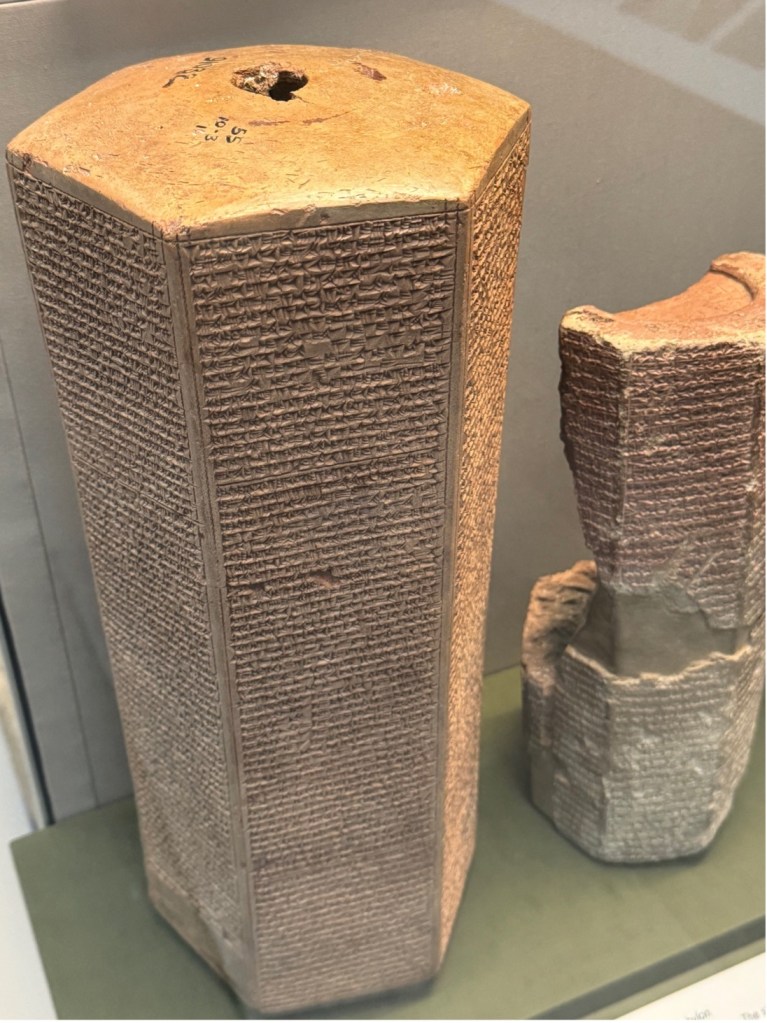
We also saw the Taylor Prism. On its six sides it lists the campaigns of the Assyrian King Sennacherib from when he took power in 705 BC until his final war against Babylon. It also tells of tribute from Hezekiah, King of Judah. These finds are a gift from God to provide lasting testimonies to the events of Scripture.
After seeing so much during both visits, my heart was full of joy and my mind was satisfied.
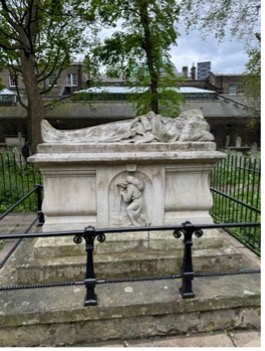
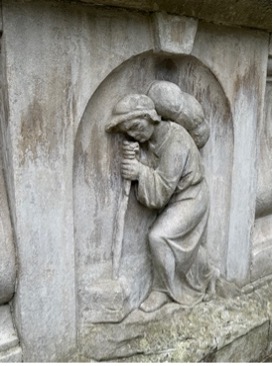
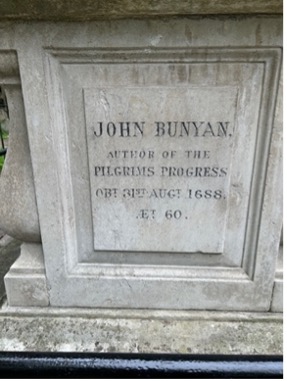
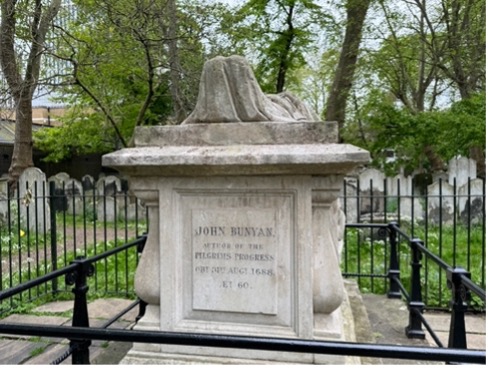
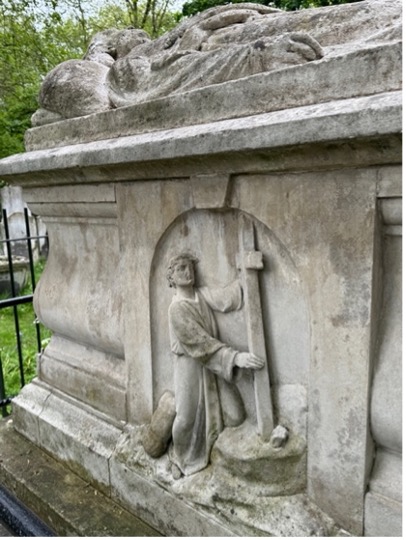
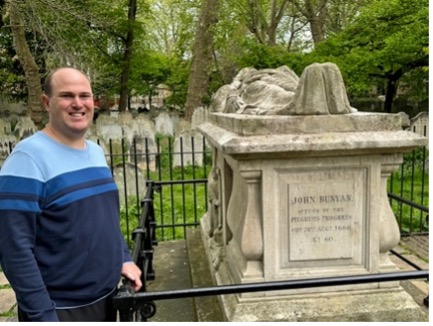
Another interesting site in London is Bunhill Cemetery, where many notable nonconformists were buried. I love the book Pilgrim’s Progress by author John Bunyan, and we found his burial plot in this cemetery. His book uses allegory to portray a believer’s journey through life, and Bunyan’s tomb includes scenes from the story, including the pilgrim carrying the weight of sin on his shoulder. One the other side of the tomb, you can see the pilgrim releasing his burden because of the redemption he finds at the foot of the cross of Jesus Christ. What a powerful message on display for the public to see. We can be forgiven of all our sins because Jesus paid the penalty in our place for our sins. What a most precious visualization of sacrificial love. We cannot repay or truly fathom God’s love for the sinner in granting us forgiveness and salvation. John Bunyan was saved by God, and his gravesite stands and bears witness to the Gospel that saved him. We too can have this gift of everlasting life when we believe in Jesus Christ and receive Him by faith, so that we too can be released from the bondage of sin.
Westminster Abbey was an incredible and grand place to visit. In large part, it is an indoor graveyard honoring the dead who made significant contributions. Please note the honor given to those who gave their life for the cause of Christ.
My experience walking around London
The best way to get around London is by foot. Walking is my strength, and I seldom grow weary. I love the freedom to go and look at everything, and I love to conquer the territory and see as much as possible. I find it interesting to hear all the accents and the variety of languages spoken as we walked past conversations or as we stood in the queue or sat at a table eating a snack or meal. We were all enjoying ourselves, and we were blessed by the kindness and friendliness of strangers. When the rain all at once poured down, we found warmth inside the British Museum, the Churchill War Room, the Westminster Abbey, and the Tower of London. We could stay and enjoy learning all we could without being in a hurry. We processed all we learned as we walked outside. We also used the underground train system. My brother Stephen was great at navigating and buying the tickets. I find this mode of transportation the most nerve-racking. The train doors close quickly, and you want to get through together as a family. One time the door closed as I was stepping onto the train. It gave us all a scare because we were going to be separated, but gratefully it worked out. As the loudspeaker often reminded us, you have to mind the gap between the platform and the train, and you have to quickly board the train regardless of how full it is. It is exciting, but I admit that it made me nervous. I am grateful for my family who looks out for me, and I am glad to report we made it everywhere safely. Traveling is a privilege, and we would recommend exploring London.
What fun and treasured moments, Nathan. I always appreciate your eloquent and poetic style of writing. It helps to transport the reader into the world you are describing.
I am glad you took the time to share some of your vacation. I have never traveled to England. It was a delight to see the pictures and read the explanations of the places you visited. Almost like I was there myself.
My favorite was the pictures and description of John Bunyan’s grave, as that is also a book I enjoy reading over and discussing with others. I cannot imagine what it would be like to have lived in that time period and how difficult it was for John Bunyan. We are surrounded by so many blessings today in our lives because of the sacrifices of those who came before us. It will take a good part of eternity to acquaint ourselves with all these saints who have helped us to understand some of the
keys for the kingdom. Thank you for sharing and looking forward to part two. May the Lord continue to bless you as you encourage others for Him. Debbie Oberlander
This was so interesting, Nathan. I also love the British museum, and walking around London. I haven’t been to the Bunhill Cemetery, but now I’d like to go. I did actually get separated from my family on the Paris metro once, so I know how you felt.
Thanks for sharing your reflections Nathan. Love to hear of your adventures! You still have all your other countries to write about!Love,Aunt KathySent from my iPad
For everything there is a season, and a time for every matter under heaven:
a time to be born, and a time to die; a time to plant, and a time to pluck up what is planted; a time to kill, and a time to heal; a time to break down, and a time to build up; a time to weep, and a time to laugh; a time to mourn, and a time to dance; a time to cast away stones, and a time to gather stones together; a time to embrace, and a time to refrain from embracing;
Ecclesiastes 3:1-5
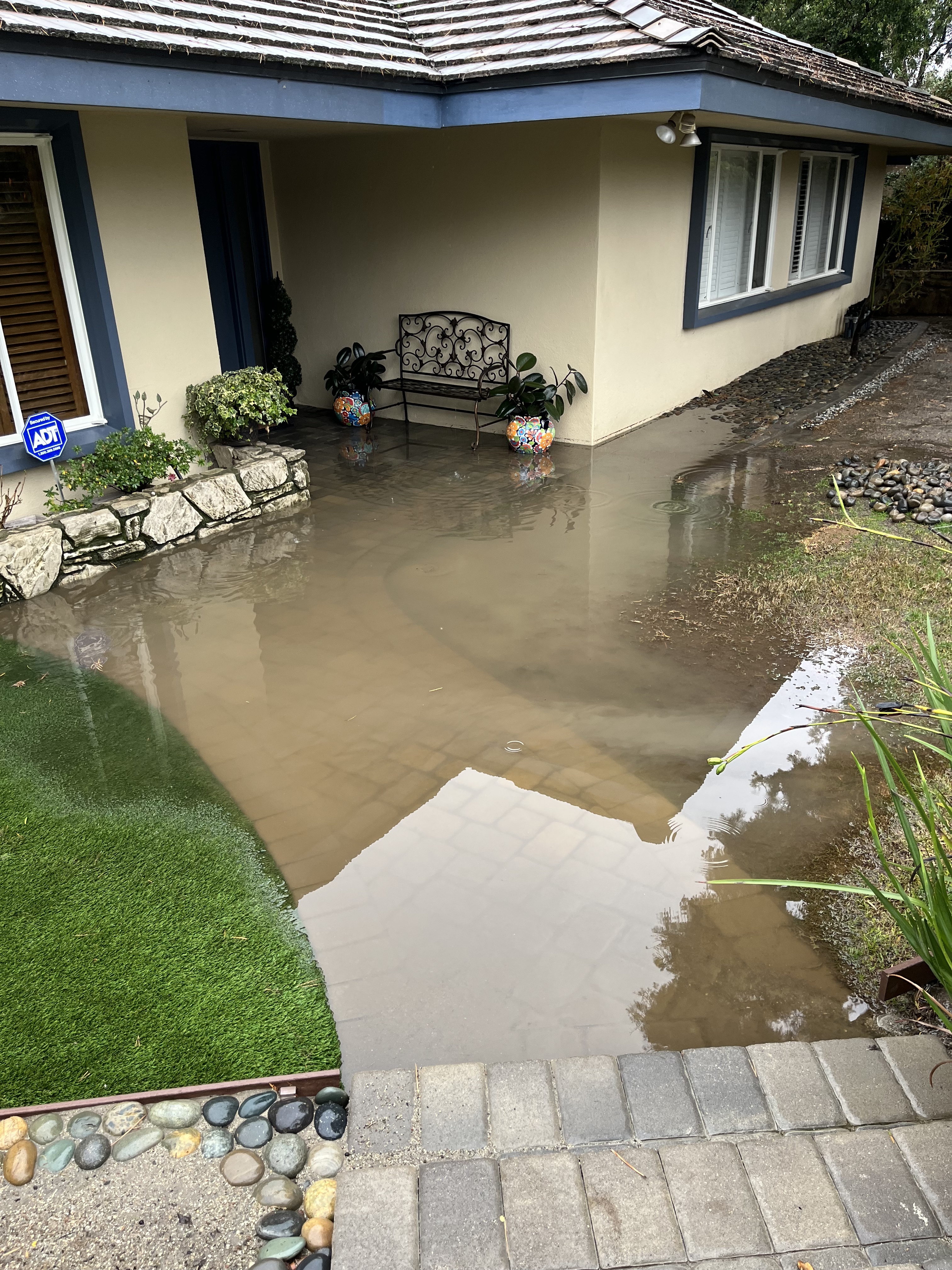
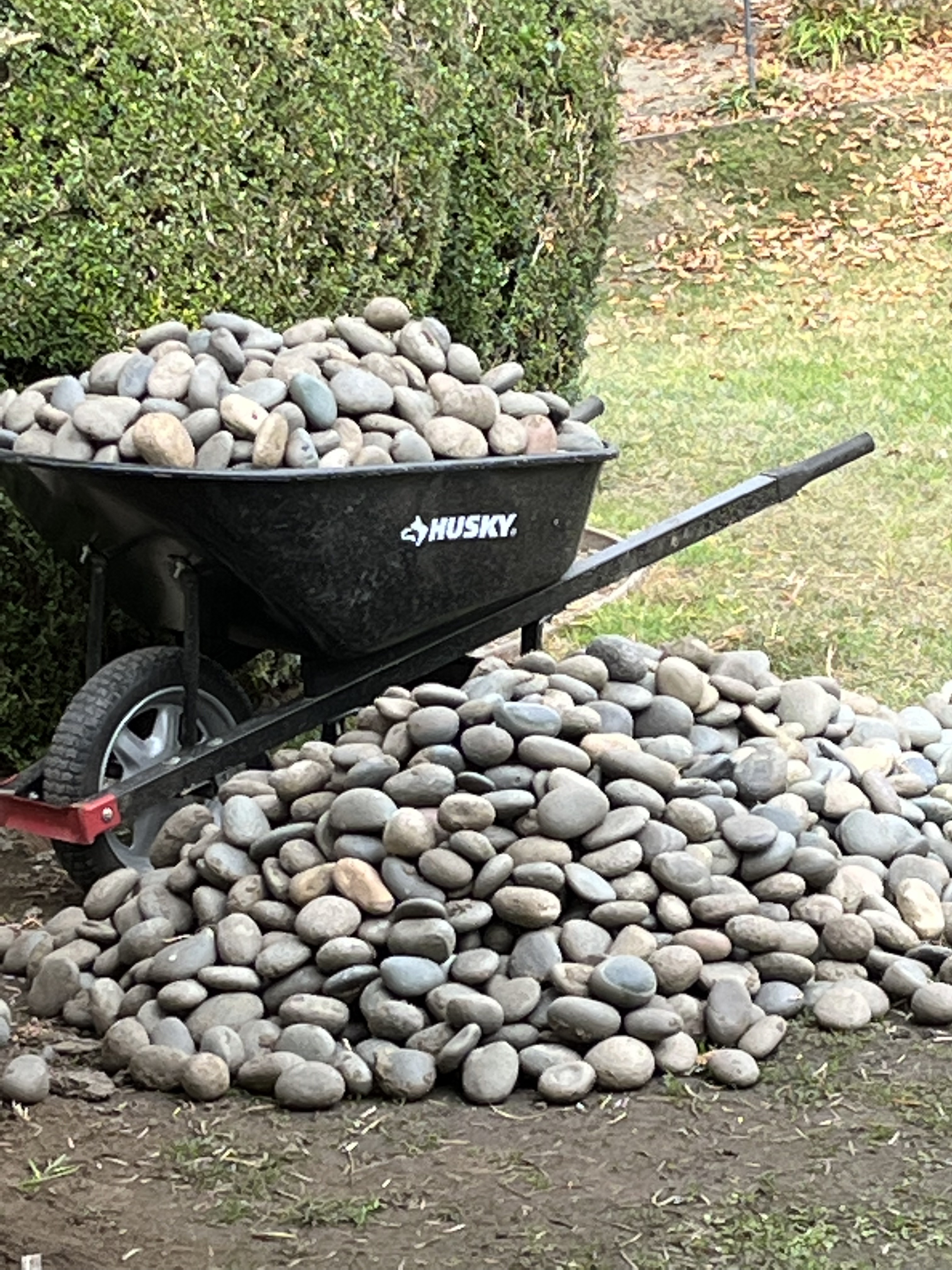
Hello, friends of the blog. Some of you may be wondering what I have been doing since I graduated and finished studying at BIOLA. I have been reading, exercising, traveling, and moving rocks to create rock paths and planters at our home. This has been a time to be less about me so that I can help my parents to fix the water damage under our house and deal with the water leaking through our roof and from our new air conditioning unit. It has been an education in itself to learn about these things and maintaining them. To stop continued water damage, we abandoned sprinklers and changed our landscape to rock gardens. I found great joy in being able to help in a tangible way by carrying and sorting the rocks. Presently, we are just a week away from completing our projects—which started in September 2022!
With time soon freed up from working on the household repairs, I look forward to recounting my observations and reflections from my reading, which includes Tolkien’s Lord of the Rings, Lewis’ The Chronicles of Narnia, The Story of Christianity by Justo L. Gonzalez, Knowing Sin by Mark Jones, and Truths We Confess by R.C. Sproul. There are many truths to digest from these books, as the authors capture biblical teaching in memorable ways so that we might obey in earnest what God desires from us. R.C. Sproul uses the Westminster Confession of Faith, which pulls from the Bible the tenets of the Christian faith and explains how we are to know God and live according to His Word. To look past the creeds and catechisms that have rightly instructed for centuries is a fatal mistake of our generation, especially when many seek to bend Scripture to adapt to our culture. A false teaching of man can too easily replace God’s timeless instruction for humanity. The confessions can serve to not only teach us, but also to provide accountability. If we create doctrine to adapt to our desired way of living, we are not accountable to God, but to ourselves and to our fancy.
I am happy to report to you that I am grateful to be alive and well, and just as there is great satifaction completing a homework assignment or reading a good book, I have enjoyed helping complete house repair projects. Whatever the day consists of, I pray God helps me do it with all my might and an appreciation for God giving me the opportunity. If we value those things which seem to be little, I find that my heart is in a grateful stance, and when the mighty things come, I treasure them with even greater joy. We know there are no guarantees for our plans to come to pass, but if you have committed your life to God, nothing thwarts His plans, and because of this I am grateful for His good plans which give us a hope and a blessed peace during these turbulent days.
I perceived that there is nothing better for them than to be joyful and to do good as long as they live; also that everyone should eat and drink and take pleasure in all his toil- this is God’s gift to man.
Ecclesiastes 3:12
If you would like to receive my writing in your inbox, please enter your email below:
Praise ye the Lord. Blessed is the man that feareth the Lord, That delighteth greatly in his commandments. His seed shall be mighty upon earth: The generation of the upright shall be blessed. Wealth and riches shall be in his house: And his righteousness endureth for ever. Unto the upright there ariseth light in the darkness: He is gracious, and full of compassion, and righteous. A good man sheweth favour, and lendeth: He will guide his affairs with discretion. Surely he shall not be moved for ever: The righteous shall be in everlasting remembrance. He shall not be afraid of evil tidings: His heart is fixed, trusting in the Lord. His heart is established, he shall not be afraid, Until he see his desire upon his enemies. He hath dispersed, he hath given to the poor; His righteousness endureth for ever; His horn shall be exalted with honour. The wicked shall see it, and be grieved; He shall gnash with his teeth, and melt away: The desire of the wicked shall perish.
Psalm 112 (KJV)
Today marks three years since my Opa left behind this mortal life for the rest of eternity. There is not a day that goes by that I do not miss his wonderful presence, and I thank God continually for him and for the privilege of being his oldest grandson. I am happy to say I had an earthly hero in him. Opa’s influence continues to bless me, especially since I know he started each day by praying for me to grow in my love for God. He showed me how much he loved God by his actions. Prayers flowed freely from his lips and his joy in reading and memorizing passages from the Bible was evident. He regularly dispensed wisdom and he sought to mortify his sin with a holy hatred of it. Few men have a front row seat to true, loving greatness, but I did. I will cherish his memory with the knowledge that we will be together again. I look forward to worshiping God in His presence with Opa.
On this Christmas Eve, I want to express my appreciation to those of you who have so kindly signed up to receive my blog posts and have encouraged me. As the year comes to a close, I also lift my praise to God for another year of His blessing that I will never forget.
I enjoyed a wonderful milestone when I earned a degree in Biblical Studies from BIOLA University in May. After nine years of study with gifted professors who believed in me, I had the great joy of walking across the finish line to receive my diploma. For someone with my disability, this was thought to be impossible. I was told I was the first to graduate from BIOLA with my diagnosis. But that is how God works—He is sovereign and nothing is beyond His ability, even with unprecedented circumstances. He orchestrated the incarnation of the Son as the Christ, Jesus of Nazareth, who came not as a warrior king with immediate prominence, but instead was born to a virgin in a humble setting. God entered the world as all babies do, even to a young, poor girl. He is not an exclusive savior to the elite. He is for you and for me. I am so grateful He did not overlook me or hold my special needs against me. Even with my weakness, I was able to believe the Bible which proclaims the cherished Christmas story of Jesus born in Bethlehem. Moreover, I believe that Christ died and was buried, but on the prophesied third day, He did the “impossible”—He rose from the dead in power and left behind an empty tomb. Now for all who come to Him in belief and repentance, we receive salvation and the blessed assurance of eternal life. It is not “impossible”—nothing is impossible for God. As we celebrate the Child who came to save us, I am grateful to be God’s child. May this Christmas celebration be a beautiful time of adoring Jesus, God in human flesh, and trusting in Him as Savior to receive full assurance of life eternal with God in heaven. This hope we have allows us to face each day and the year ahead with full certainty that God is with us and nothing is impossible for Him.
May we rest in His sovereignty which allows us to trust Him completely.
If you would like to receive my writing in your inbox, please enter your email below:
With a joyful heart overflowing with thanksgiving, the psalmist concludes with his opening refrain. This psalm serves as a wonderful model for prayer as we reflect on all of God’s blessings which are so richly and undeservedly bestowed on His children. To contemplate that He loves us with an everlasting love is overwhelming, and it is a love no one else can give us. We are never not loved by God, not even for a moment. He is righteous and holy, which means our sin makes Him justly angry. But His love through the Holy Spirit softens our hearts to bring us to repentance, and God will always forgive us, cleanse us, and refuse to hold our sins against us.
We know our place—God made us from the dust. Even in our lowly status, the creature can, and must, worship God the Creator. We magnify God’s attributes by expressing them aloud, and as the psalmists concludes, he blesses God for all the benefits found only in Him. Only God can forgive our sins because He sent His Son to fulfill the Law and be the perfect, final sacrifice. All of our sin was placed on Him, and He bore the wrath of God that we deserve. Otherwise, we would be without hope and separated from God because of our sin. Believer, may we never stop thanking God for His provision and salvation, cleansing us completely and clothing us in His righteousness, which is the only firm foundation for an everlasting relationship with a holy God. We cannot take the cost and gift of salvation lightly.
It is also remarkable that the psalmist wrote this psalm long before Christ’s incarnation, crucifixion, and resurrection even happened. The psalmist could only see the shadows of the full picture of redemption. We have the benefit of living on the other side of redemption’s accomplishment. How much more we can praise God and live righteously with the power of the Holy Spirit in us, which gives us cause to thank God for His life-changing, eternal gifts. My soul sings, “Bless the Lord, my Rock, and my Redeemer!” With joy may we live for God’s glory—hating sin and loving righteousness. “To the King of the ages, immortal, invisible, the only God, be honor and glory forever and ever” (1 Tim. 1:17).
If you would like to receive my writing in your inbox, please enter your email below:
As the psalm comes to a conclusion, the psalmist makes the all-important affirmation that God is the Creator and has dominion over all. Such a declaration brings Psalm 19:1 to mind: “The heavens declare the glory of God, and the sky above proclaims his handiwork.” The world, and all that is in it, was created by God, and God proclaimed that it was very good (Gen. 1:1, 31). The beauty of the universe magnifies God’s creativity and exalts Him as the majestic designer. It is His kindness which allows everyone to enjoy His handiwork, because the benefits of His general revelation extend to the just and the unjust. In hell, however, these benefits will be taken away from the wicked, but in the meantime, they are used by God to bring man to repentance and into a relationship with Him. No excuse can be made that God has not revealed Himself to all mankind. The apostle Paul makes this clear in his letter to the Romans when he writes, “For his invisible attributes, namely, his eternal and divine nature, have been clearly perceived, ever since the creation of the world, in the things that have been made. So they are without excuse” (Rom. 1:20). Creation testifies to the presence of God, and it is the duty of man to respond in worship and adoration.
God not only made creation, but He controls creation. Upon His entry into Jerusalem, Jesus was praised by the people with the refrain, “Blessed is the King who comes in the name of the Lord.” The Pharisees complained to Jesus about this, but His response revealed that He was worthy of such praise and that His creation would attest to the same truth: “I tell you, if these were silent, the very stones would cry out” (Luke 19:38, 40). God’s dominion is in the heavens and throughout the earth. He created and sustains everything, which magnifies His glory. The pagans assigned gods to specific parts of creation—the sun, the rain, etc. They created each of their gods and served them, hoping for some desired outcome if they satisfied their desires. But Jehovah is not dependent on man for anything, and is not constructed by any man. It is man who needs God for everything, including each breath we take. All the phenomena we see in the natural world humble us with the reminder that we are not in control, but God is.
Before the assembly of the people, King David announced his son Solomon would be king and prayed the blessing, “Yours, O Lord, is the greatness and the power and the glory and the victory and the majesty, for all that is in the heavens and in the earth is yours. Yours is the kingdom, O Lord, and you are exalted as head above all” (1 Chron. 29:11). We join creation and bless our Creator with our worship and praise. We have been greatly blessed by God. What a privilege it is to thank Him for everything He has created for us.
If you would like to receive my writing in your inbox, please enter your email below:
Bless the Lord, all his hosts, his ministers, who do his will!
Psalm 103:21
These last verses repeat a similar phrase to signal the importance of obedience by enjoining “those who do his word…obey the voice of his word…and who do his will” to bless the Lord. We can only bless the Lord with consistency—whether it be His angels or His children—if we are obeying the will of our God and submitting ourselves to Him. If we follow the pattern of this psalm, we begin by acknowledging our trespasses and sin, but we also praise the Lord who forgives and cleanses us. As a cleansed vessel we can bless the Lord because we are loving Him in obedience to His will.
On the other hand, the unrepentant sinner is disobedient and cannot fulfill or even desire to do God’s will. In the Garden of Eden, in the moment of their disobedience, Adam and Eve went against God’s clear instruction. They immediately needed a savior from their death sentence, since this was God’s promise upon their trespass. Satan tempted them to question God’s design and perfect plan, which ultimately brought a curse upon the entire human race. Sin leaves us hopeless until we are made children of the eternal Father whom the psalmist leads us to praise. We can rejoice as we count His magnificent blessings of forgiveness, healing, redemption, righteousness, mercy, steadfast love, and the promise of everlasting life with Him. When we reflect on these blessings in our own lives, our hearts cannot help but overflow with a thanksgiving that moves us to love Him in obedience, which is the proper context for us to bless the Lord.
We cannot confuse this with the vain hope of meriting God’s love or salvation with our works, but rather our works acknowledge that He is our Savior whom we honor and give glory with our obedience. James, Jesus’s half-brother, explains, “Faith by itself, if it does not have works, is dead…I will show you my faith by my works” (James 2:17-18). Instead of disobeying God’s commands, or being burdened by them, we show God honor and our full trust in Him when we echo the psalmist, “For I find my delight in your commandments, which I love. I will lift up my hands toward your commandments which I love, and I will meditate on your statutes” (Ps 119:47-48). We obey whom we love, and loving God is living in obedience to His Word.
If you would like to receive my writing in your inbox, please enter your email below:
Bless the Lord, O you his angels, you mighty ones who do his word, obeying the voice of his word!
Psalm 103:20
Angels Appearing to the Shepherds, Rembrandt (1634)
As the psalmist brings the psalm to a crescendo, we are transported to the heights of heaven, where God’s angels obediently do the work of the Lord according to His instruction. Yet, the psalmist still exhorts even the angels to bless the Lord. In Revelation, John describes the myriads—thousands of thousands—of angels around God’s throne in unison saying with a loud voice, “Worthy is the Lamb who was slain, to receive power and wealth and wisdom and might and honor and glory and blessing!” (Rev 5:11-12). We will one day join these faithful angels in heaven to praise to God, another reminder of the great hope we have ahead of us.
It is important to recognize that, though the angels are pure, heavenly creatures, they do not act independently, but rather they carry out God’s will. The Bible tells of the work of the angels in both the Old and New Testaments. It was an angel who took Lot by the hand and saved him from the destruction of Sodom (Gen 19:16). It was an angel with a coal from the altar who cleansed Isaiah (Is 6:6-7). Angels appeared to Abraham and Sarah with the message from God that Sarah would become pregnant, and in the New Testament it was the angel Gabriel who told the virgin Mary she would conceive in her womb and bear Jesus (Luke 6:26-33). Gabriel also previously visited Zacharias to tell him that his wife would conceive and give birth to John the Baptist (Luke 1:11-15). It was a host of angels who proclaimed the birth of Jesus to the shepherds (Luke 2:13). The angels also rejoice in heaven when anyone receives Christ as their Lord and Savior (Luke 15:7, 10). The angels are obedient and devote themselves to praising God, so it is instructive for us to do the same already on earth. The angels also teach us that we bless the Lord as we live in obedience to the Word of God with the Sprit’s help. I thank God that we can learn from these angels. With our eyes focused on God, He will keep us in perfect peace with delight to serve Him wholly.
You keep him in perfect peace whose mind is stayed on you, because he trusts in you. Trust in the Lord forever, for the Lord God is an everlasting rock.
Isaiah 26:3-4
If you would like to receive my writing in your inbox, please enter your email below:













 Keys for the Kingdom
Leave a comment